

The Way to Buy
The Stock Investing journey begins with the mammoth task of choosing from over 4,000 listed companies in India. How do you pick a handful of promising ones? Pore over the financial reports of each of them? That’s an improbable Task. So what do you do? The answer lies in doing what you do in just about any other sphere of life. Think about how you go about buying a pair of shoes. When you walk into a showroom, there are literally hundreds of pairs vying for your attention. How do you choose one? Do you try each one of them? Of course not. Instead, you reduce the number of options by filtering out the ones that don’t match your preferences. These could be related to the style of the shoe (Oxfords, Loafers, Etc.), material (Leather, Suede, Canvas, Etc.), colour (Black, Tan, Beige, Etc.), price range or any other. This way, you save a lot of time and effort by eliminating a vast majority of options using an objective set of criteria. For the handful that remain, you do a much more involved evaluation on parameters such as looks, quality, comfort, fit, etc. before making a purchase decision.
Your stock selection process should be no different. You should prune your universe of stocks through a set of quantitative filters followed by a rigorous evaluation of the handful that remain.
Read on as we lay down a roadmap for you. It will give you a glimpse into the process our analysts follow in their stock selection process.

1.1 Run your screens
Stock evaluation is a highly engaging job best done on a limited number of stocks. You should devise a set of quantitative criteria to eliminate the ones that don’t deserve your time.
You’d be surprised to find how many of the 4,000-odd listed firms fail to cross even the most basic filters, leaving you with a much more manageable number to deal with. For starters, here is a set of easyto-apply filters.
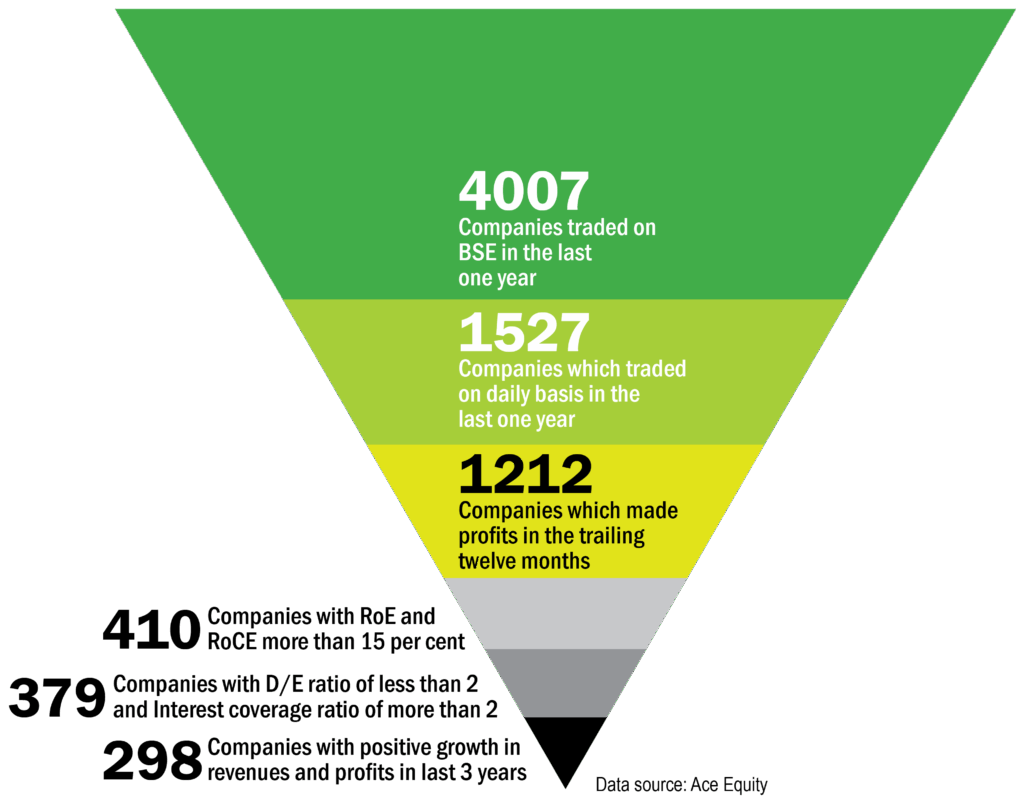
1. Actively traded
The stock should have traded daily in the last one year
2. Profitability
- The company should have made profits in the trailing twelve month period
- Return on Equity (ROE) and Return on Capital Employed (ROCE) of more than 15%
3. Growth
Positive growth in revenue and profits in the last three years
The Stock Screen tool available to you on Stock Advisor website can greatly help in screening on the basis of quantitative filters. You even get a set of pre-defined screens based on the parameters used by some of the world’s greatest investors such as Ben Graham and Peter Lynch. Give it a go!

1.2 Know the company
When it comes to investing, a rose by any other name is a rose – but you must sniff it well to find out.
Once you have reduced the number of investment worthy prospects through screening, you need to research them deeply to handpick the genuinely compelling ones. Always remember, stock investing is about becoming a partial owner in a company, not just buying electronic entries on a stock exchange. And before becoming a part owner, you must understand its business like an owner should. We have put together a list of questions you should seek answers to.
But remember, its not always easy to get answers to these questions, especially if you are dealing with a complex business. Therefore, its always better to stick to the businesses you can actually understand.
Who are the people behind the company?
Your quest to know about a company should start with its promoters and top management. A company is only as good as the people running it. No matter how good it looks on other parameters, if there are doubts about the credibility of people running it, you should steer clear of it.
This is no different from how you would conduct in any other walk of life. Would you buy groceries from a store that stocks expired products? Or electronics from a guy selling cheap replicas of the branded ones? If you’re unwilling to deal with a deceitful company as a customer, owning one should be out of question.
Read about the background and other business ventures of promoters. Try to find out if there are any cases of fraud, misconduct or unethical behaviour against them. Be wary of any business practices which are detrimental to the interests of minority shareholders, such as dilution of equity.
Some signs of these are visible in the financial statements of the company itself. For instance, the section on related-party transactions can yield some interesting insights. If you find instances of the company extending credit on very favorable terms to other firms which are unrelated to its business but owned by the same promoter, be suspicious. It could be a tactic used to steal cash from the company.
What a good vs bad promoter can do to a company is perhaps best illustrated by the difference in the fortunes of Indigo and Kingfisher Airlines.
How does it make money?
Once the promoters and top management pass the credibility filter, focus on understanding what does the company do for a living. Spend time going through the company filings to find out what keeps the cash registers of a company ringing. This may seem obvious but you’ll be surprised to find the variation between what a company actually does versus what the general perception about its business is in so many cases.
For instance, which product comes to your mind when you think of Titan? Do you know it earns a mere 16% of its revenues from watches? Or the fact that Tata Motors earns much more money from Jaguar Land Rover than from selling Tata cars in India? Would you be surprised to know Rolls Royce (the company) doesn’t make cars any more, a business it sold way back in 1998?
There can be much more to a company than meets the eye, more so in case it operates multiple businesses. You should focus your attention on the segments that make or break its fortunes.
Does it have a moat?
Once you’ve identified the products and services that are the mainstay of the company, try to find any attributes that will help the company sustain its position of strength in those business segments. Basically you need to find out if the business has any ‘moats’.
In ancient times, moat used to be a deep, wide channel of water around a castle. Predators like crocodiles would sometimes populate the moat, keeping enemy soldiers away. In modern times, the term is used to describe a competitive advantage that gives a company an edge over its competitors and therefore helps it defend its business.
In its simplest form, think of a competitive advantage as the ability to produce a product or service that competitors cannot copy and sell easily. Coal India has a competitive advantage by virtue of its monopoly over coal mines.
Look for the evidence of a moat in sustainable cash generation and profitability. How does the company manage to keep competitors away from snatching its market share and profitability? Is it likely to continue doing that for a long time?
Competitive advantages usually arise from the following:
Patents and technology: Think Windows. It has had 90% of the global desktop PC market to itself for many years. Technology is a source of competitive advantage. Oracle and SAP both enjoy moats based on their enterprise software ecosystems. Adobe has its moat in Photoshop.
Branding: Think of the iPhone. Apple has created such a brand that it has fans all over the world lapping up the latest release, whatever the price. Many fans form queues the day before a new launch or even earlier, so that they can get their hands on one. That’s the power of branding. Very few products can claim such a customer following.
Low cost: Being a low-cost producer enables a company to earn higher profits than competitors and weather a slowdown better.
Switching cost: This is the cost, both monetary and otherwise, of customer switching from one product or service to another. It can be monetary when the switch involves a cost to it. If you are an iPhone user, switching to Android means that you could stand to lose usage of all the apps that you bought on the Appstore. You will have to buy those apps again on Android (monetary costs). It is possible that there is no Android version of the iOS app that you are addicted to (non-monetary switching cost). Apple, in this case, has made switching to Android an expensive proposition.
Wide network: An unmatched network of branches across the length and breadth of India provides a tremendous scale advantage to State Bank of India. The deposits it has amassed as a result of its reach towers over those of next four biggest Indian banks combined.
Companies with strong moats are a source of great returns for investors. Over long term, stock performance follows business performance. And sustainable performance comes from moats. But remember that moats are not set in stone. They grow stronger as well as weaker over time.
Does it have a consistent track record of profitability?
Profits are the rewards for equity investors which you reap either in the form of dividends or by way of appreciation to the stock price. Over the long-term, you will see a strong positive correlation between stock price and earnings. Peter Lynch once famously commented that earnings are the only form of growth that counts.
Don’t get carried away by the meteoric rise of a company if it isn’t backed by profitability. The flurry of e-commerce startups in India, particularly in online retail, are a glaring example of this. A large number of them were characterized by rapidly bulging top-lines without a rupee of profit to show at the bottom. Many were in fact losing more money to generate every additional rupee of sale.
This didn’t make economic sense and reality has caught up resulting in large scale value destruction as they downsize, shut shop or undergo distressed sale.
As an investor, you should never lose sight of the basic premise of a good business – it should be able to sell, whatever it is that it produces, for slightly higher than the cost it incurs to produce it. If it isn’t, it’s not worth your money.
Are the profits backed by cash?
Just like any other economic activity, businesses run on cash. It is the lifeline of companies. More often than not, they fail because they run out of cash. Therefore, you must ascertain if it generates sufficient amount of cash to pay for the cost of its operations – rents, materials, interest, salaries and the like. The trend in the firm’s cash flow from operations (CFO) can provide good insights on this. If the company has debt on its books, you should also ensure that the CFO comfortably exceeds the annual interest payment. You should also watch out for rising short-term loans, meant mainly to finance working capital. It indicates that the company is not generating sufficient cash for its day-to-day operations.
Besides, you should also check whether the operating profit and cash generated by a company move in tandem. In the simplest of cases, operating profits should be equal to cash generated in a year. But in reality there are a lot of non-cash items, such as depreciation, credit sales and purchases, etc. which cause divergence in profits and cash realization.
This could be due to the nature of the business itself and therefore, not a major source of concern. One such example is real estate where the income is realized later and hence the cash flow is not commensurate with the profit booked.
On the other hand, it can be a sign of poor management. For example, the company may not able to realize cash from its debtors on time but has to pay to the suppliers early. A sustained and large difference between operating profits and CFO may escalate the working capital requirements and squeeze liquidity.
Is there a threat to the company’s solvency?
Companies typically run into solvency issues when, in their bid to expand too fast, they raise far more debt than they can service. Any moderation in their business environment or a reversal of market cycle can put great stress on their balance sheets, pushing them towards bankruptcy. The debacle of Kingfisher Airlines illustrates this well and at a broader level the entire non-performing asset (NPA) mess that Indian banks are struggling with is a by-product of solvency issues faced by some of the leading Indian companies.
As an investor, you must check if the interest coverage ratio (the relative size of a company’s earnings to its interest costs) is high enough. A debt to equity ratio above 2 is also concerning. Here’s an interesting insight. From amongst the current constituents of the BSE Sensex index, barring three companies, the debt equity ratio of the remaining 27 has never crossed 2 in their entire life. This goes to show that companies needn’t stretch themselves too much with excessive debt in their bid to become big.

From amongst the current constituents of the BSE Sensex index, barring three companies, the debt equity ratio of the remaining 27 has never crossed 2 in their entire life.
Altman Z-score is another very useful measure for you to gauge the likelihood of a company going bankrupt. A Z-score of more than 3 is usually considered safe. You can get the Z-score of Indian companies on their stock pages at the Value Research Stock Advisor website.
Are there any other issues you should be worried about?
Our analysts explore several other dimensions to try and unearth potential issues in a company. Here are some of the more prominent ones you must not ignore.
Promoter holding: If you notice a sustained drop in promoters’ holdings, it could be a sign of them losing confidence in the company. The trends in Satyam Computer’s promoter and CEO, B Ramalinga Raju’s holdings in the company is an interesting case in the point. Between 2002 and December 2008, his stake in the company fell from 22% to just 2%. By the time the Satyam scam broke out in January 2009, the captain had fled his sinking ship.
Pledging of shares: Pledging means promoter borrowing money against shares as collateral. You should be concerned if a significant proportion of promoter’s holding in a company is pledged. Defaults on such loans can lead to a vicious circle, where the stock price tumbles because the lender sells pledged shares to recover its dues.
Lack of consolidated numbers: Another situation which calls for doubt is when the company does not report consolidated financials despite having meaningful subsidiaries, or delays publishing its results quite often. Sometimes companies also create a special purpose vehicle but leave out details while filing their financial reports
Changes to accounting policies: Check if the management is changing accounting policies too often, such as depreciation method, inventory-valuation method, etc., to fit its purposes.
Loans to service existing debt: Taking loans for a strategic expansion may be acceptable but a loan taken to service an existing debt raises suspicion. One should stay away from such companies.
Top management exits: Serial resignation by several key personnel or board members in a short span signals trouble brewing up

1.3 Keep a margin of safety
Once you find a company you’d like to own, don’t pounce on it at once. See if it is available at a reasonable price, else wait.
Many investments in quality companies do not produce desired returns if the valuations are steep. Benjamin Graham (Warren Buffet’s guru) articulated this very concern when he wrote that investors who buy companies at hefty premiums are at the mercy of uncertain future prospects. Quality stocks result in outperforming portfolio gains in the long run only when they are purchased at reasonable valuations. On the other hand, expensive valuations leave little on the table for new investors. This is a big reason why you should not follow the crowd into a market favourite but ensure that you have a reasonable margin of safety built into it.
However, it is easier said than done. Margin of safety often takes a back seat when stocks are market favourites and the only way prices appear to be headed is up. You are under pressure to buy or miss the opportunity.
Well, it’s better to let the opportunity pass than to buy at an unreasonable price and repent later. Patience pays in stock markets. Time and again, markets behave irrationally providing wonderful buying opportunities at prices which are worth the wait.
That leads us to the question – how do you find out the real worth of a company? Well, it is tricky. Different people follow different approaches and come up with completely different valuations for the same stock.
One of the popular ones is the discounted cash flow technique where you estimate what the future cash flows would be like and then discount them back at an appropriate interest rate. This may sound straight-forward but involves a lot of complexities. Your valuation is just as good as your predictions of future cash flows. It requires a lot of practice and a deep understanding of the business environment a company operates in.
There are other easier approaches to assess whether the valuation is reasonable or out of whack. They are not foolproof but certainly helpful to nudge you in the right direction.
Peter Lynch’s method
Famed investor Peter Lynch used what is today known as the PEG (price-to-earnings growth) ratio to estimate the fair value of a business. According to Lynch, if a company’s earnings grew by 15 per cent, you can buy the stock at a P/E ratio of 15 (PEG ratio of 1). A PEG ratio of less than one is attractive and that of more than one unattractive. A PEG ratio of half is very attractive and that more than 2 is very unattractive.
Earnings yield method
Earnings yield is calculated as the earnings per share of the company divided by its share price. For instance, a stock with an earnings per share of Rs 40 and trading at Rs 400 will give you an earnings yield of 10%. The idea is to buy stocks yielding well over and above the current bond rate so you have a built in a margin of safety.
Besides, several other techniques, such as relative valuation, net-net ratio, etc. are used.
The key point about valuing companies is that it is not a precise science. You should not aim to calculate the fair value of a company to a decimal point. But as long as you figure out a fair range which offers a decent buying opportunity, you should be fine.
Secondly, beware of stocks that are selling at too deep a discount. This assumes great significance if you are using the market multiples such as P/E ratio or P/B ratio to value a company. More often than not, there’s a reason why they are ultra cheap. They can well turn out to be falling knives instead of the multi-baggers you thought they’d become.
Lastly, remember that there is no one easy way to master the art of valuing companies. It is a skill you need to hone over time with practice. Even the most seasoned investors find themselves on a continuous learning curve.

1.4 Diversify but don’t overdo
Stock investing is inherently risky. No matter how deeply you research a company, there is always a possibility for something unforeseen to send a stock or a sector into a tailspin.
Take Satyam Computer Services for example. Once among the most sought after stocks, it was suddenly hit by an unanticipated scandal. Or Nokia. The advent of smart phones sent the company, until then regarded as the most cutting edge in mobile phone technology, packing. Such occurrences are not rare in stock investing.
The point is that you are bound to make bad investments occasionally despite being extremely diligent and thorough with your research. Even the best of fund managers can’t get it right all the time. The best way to mitigate this risk is to spread your money across a few stocks. That alone will ensure that the impact of the poor performers is not big enough to prevent you from earning good overall returns.

Warren Buffett said, “If you have a harem of 40 women, you never really get to know any of them well.”
But having said that, you shouldn’t keep accumulating stocks in the name of diversification either. As Warren Buffett said, “If you have a harem of 40 women, you never really get to know any of them well.”
Over-diversification achieves nothing except averaging out your returns to nothing more than that of the market index, which you could achieve effortlessly through an exchange traded fund (ETF).
So where do you the draw the line? How much diversification is adequate enough?
Typically, a portfolio of 15-20 stocks should provide adequate diversification for most investors. Beyond that, it becomes difficult to achieve any significant out-performance and the effort that you put in direct stock investing may not be worthwhile. Seth Klarman (investor and author, Margin of Safety): “The number of securities that should be owned to reduce portfolio risk is not great; as few as ten to fifteen holdings usually suffice.”
This is where astute stock investors are at an advantage over institutional investors such as mutual funds. Because of their size and regulatory constraints, mutual funds have to invest in large portfolios of 45-50 stocks or even more. But as a retail investor, you do not have such constraints. You can make bold bets on a select set of quality stocks to make the most of their upside.
But while picking them, make sure you have reasonable diversification across sectors as well. It is not prudent to be fully exposed to a single industry.
Some industries, such as FMCG, pharmaceuticals, oil and gas, utilities, are more resilient as the demand for their products doesn’t vary as drastically with economic cycles as it does with discretionary goods such luxury watches. Do you buy less food or medicines just because the economy’s going down? Or use less electricity because the economic output contracted? It would be a good idea to put at least some of your money in such industries.
If you’re new to investing and want to build a strong foundation, explore more beginner-friendly articles on our Blog, where we break down financial concepts in a simple and practical way. To understand how our approach can help you make better financial decisions, feel free to visit our About page or check out the Services we offer to support your long-term financial journey.

Aminish Sharma is passionate about personal finance and beginner investing. Through Prosperity Circle, he shares practical insights to help individuals understand money, investing, and long-term wealth building.
test comment
test reply